Thursday, July 15, 2010

O Little Town of Bethlehem

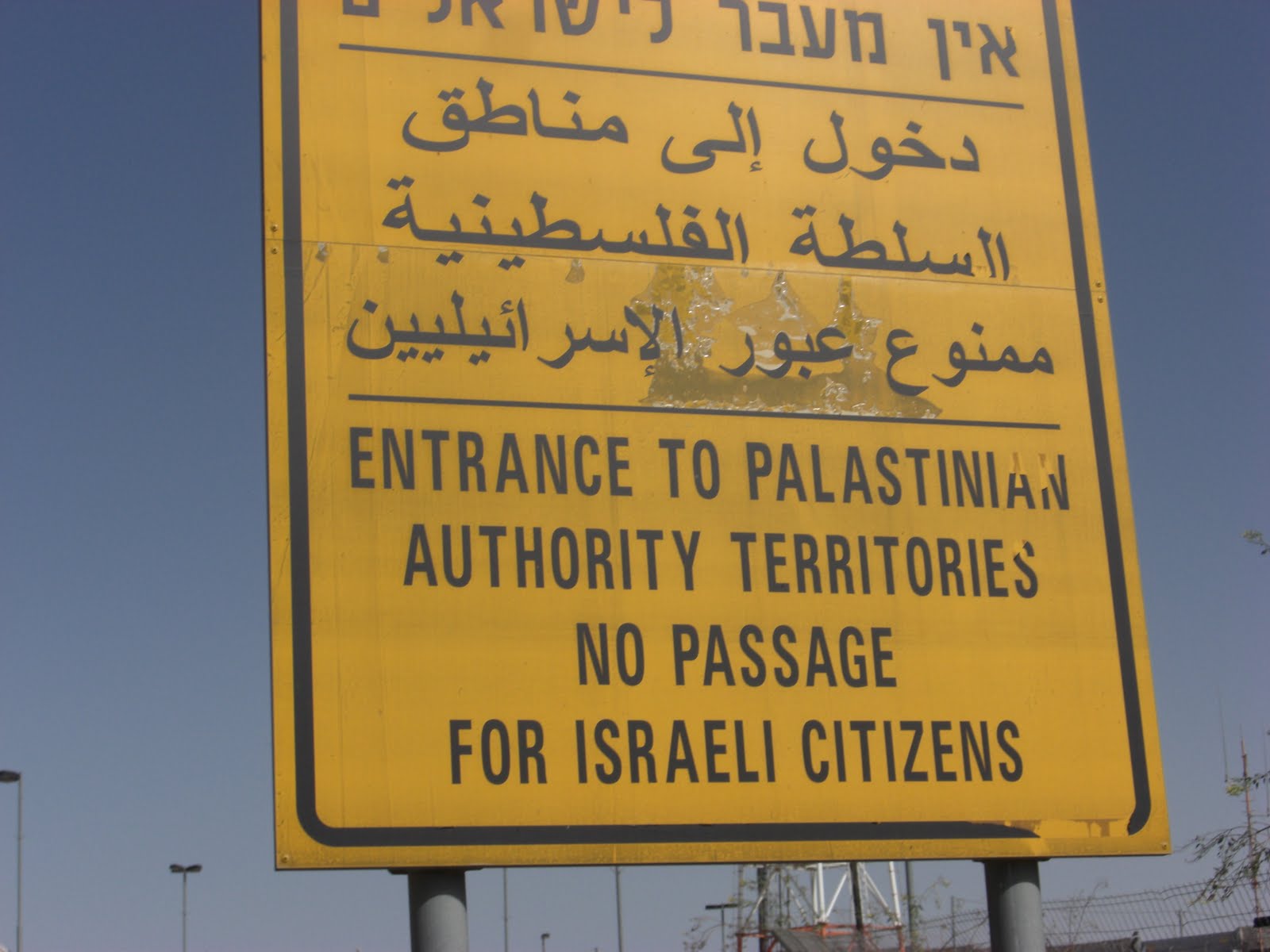
We wrapped up our tour of major Christian sites with a visit to Bethlehem, the site of the Church of the Nativity, marking the spot where Jesus was born.  Our visit was subject to security conditions, because Bethlehem falls under the Palestinian Authority.  Bethlehem is now a walled city, so to speak.  After the Second Palestinian Intifada, resulting in increased violence against Israel, the Israeli government began constructing barriers around the Palestinian Territories, as a way to curb the violence and have greater control over who passes into Israel.

The wall is very controversial.  Proponents say the wall is necessary to keep Israel safe.  Opponents say it is an illegal attempt to annex Palestinian territory for Israel.  There are even groups of Israeli settlers who oppose the wall because they say it goes against the Jewish claim that all the land is for Israel.


Bethlehem has a population of about 25,000 people.  At the time of Israeli independence in 1948, 85% of the population were Christian.  Repeated conflict and economic hardship has resulted in many immigrating to other countries.  Today, about 20% are Christian.

Passing thru the wall was tense.  Our tour guide could not go with us, because he is Israeli.  Israel (our guide) took us to a Palestinian Christian owned gift shop outside the wall.  The owner arranged for a Palestinian to take us across the border.  Kirsten, Luly, and I did not have our passports with us.  Our guide forgot to mention that (we did have Driver's Licenses, which was hopefully going to be sufficient).  We all lined up at the border.  We sped thru rather quickly, versus the Palestinians.  They have to have special permits to come into and out of Israel.


Once we were thru the checkpoint, it was like stepping into another world.  Where Israel is very modern, the poverty in Bethlehem is much more visible.


We were driven to the Church of the Nativity and met by our Palestinian tour guide, who would guide us around the site.


The Church of the Nativity is one of the oldest continuously operated churches in the world.  The church is built over the cave (manger) that tradition dictates as the birthplace of Jesus.  The main basilica that houses the grotto where the manger was located is controlled by the Greek Orthodox.  The adjoining Church of St. Catherine and Chapel of St. Jerome are controlled by Catholics. The main basilica is largely in disrepair.  The roof is rotting and much of the gold mosaics along the wall have decayed.


The grotto is still quite impressive.  We were fortunate that there were not that many people at the church the day we visited (during peak times, you can expect to wait for hours to visit the grotto).

Downstairs you can see the altar commemorating the spot where Jesus was born.


Adjacent to that are the altars commemorating the visit by the Wise Men as well as the location where the Virgin Mary laid the newborn in the manger.


We had purchased a few items back in the city, and we laid them on the star to receive a blessing.


One of the things I did not realize before was how close everything was to everything else.  For example, the city of Bethlehem is just 6 miles from Jerusalem.  The location of Shepherd's field, where the Angel of the Lord appeared to the Shepherds and told them about the birth of the Messiah was just down the hill from the manger.

Jerusalem, Part Two.

After our visit to the Western Wall, we proceeded into the Arab Quarter for lunch.  I still had falafel coming out of my ears, so I opted for Hummus and Pita bread as my meal.  We shared our lunch hour with some Israeli soldiers, who of course brought their guns with them.


Our afternoon of sightseeing revolved around the Stations of the Cross and the Via Dolorosa.  We wouldn't see all the stations, and the actual location of each one is highly debatable.  


The Stations themselves are usually a series of 14 pictures or sculptures depicting the following scenes.  We would see several on our visit.  I copied the list below from Wikipedia.


  1. Jesus is condemned to death
  2. Jesus is given his cross
  3. Jesus falls the first time
  4. Jesus meets His Mother
  5. Simon of Cyrene carries the cross
  6. Veronica wipes the face of Jesus
  7. Jesus falls the second time
  8. Jesus meets the daughters of Jerusalem
  9. Jesus falls the third time
  10. Jesus is stripped of His garments
  11. Crucifixion: Jesus is nailed to the cross
  12. Jesus dies on the cross
  13. Jesus' body is removed from the cross (Deposition or Lamentation)
  14. Jesus is laid in the tomb and covered in incense.

The first station we would visit was number 5, where Simon of Cyrene carries the cross for Jesus.


Adjacent to the 5th Station is where Jesus paused and rested his hand against the wall.  People since then have done the same thing, so of course I did too.


We  continued up the Via Dolorosa, which is surrounded by shops and stalls on either side and we made our way towards the next station and the Church of the Holy Sepulchre.


The next station, number 6, is where Veronica offered her veil to Jesus so that he might wipe his face.  When he handed it back to her, his image appeared on the veil.  Veronica is Latin means "Bearer of Victory", and while there is no mention of her act in the Gospels, both the Greek Orthodox and the Catholics have embraced the legend.


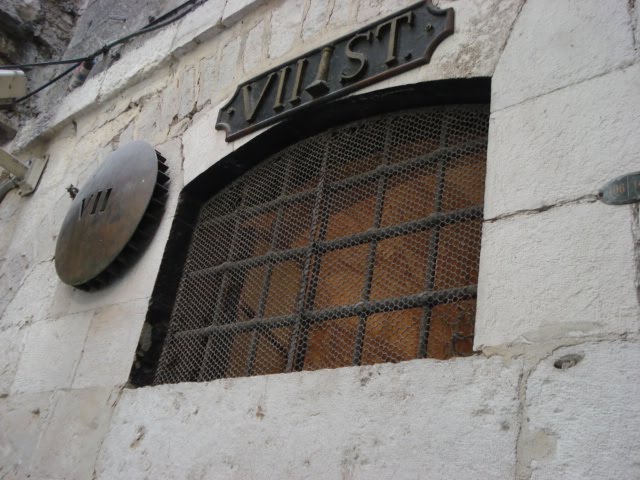
When we get to Station Seven, where Jesus falls for a second time, there are two interpretations.  According to Catholic and Orthodox tradition, Jesus went left, where today stands the Church of the Holy Sepulchre.  Protestant tradition holds that he went right towards what is today the Garden Tomb (more on that later).


The Via Dolorosa ends at what is now the Church of the Holy Sepulchre.  Tradition (depending on your denomination) holds that the church is built on the site of Golgotha, the Hill of Calvary, where Jesus was crucified.  Records indicate that Christians have been making pilgrimages here since at least the 4th century, if not earlier.  Custody of the site is shared between different Christian faiths in rather complicated agreements that go back for centuries.  The site was originally a temple dedicated to the Greek goddess Aphrodite.  The Emperor Constantine and his mother Queen Helena, had the site leveled and rebuilt as a church.    The church was destroyed in the 11th century by Persian conquerors and was a major catalyst for the Crusades, when it was subsequently rebuilt.


The stairways take you up the 11th/12th Stations of the Cross, at Calvary, where the actual crucifixion took place.  The site now houses The Chapel of the Nailing of the Cross and the Altar of the Crucifixion.


The Stone of Anointing, located at the entrance of the church is where the body was laid after being taken down from the cross and prepared for burial by Joesph of Arimathea.  This would be the 13th Station of the Cross.

The Sepulchre or Tomb, where the body was placed for burial is the final station, number 14.


File:5267-20080122-jerusalem-tomb-of-jesus.jpg

Upon entering the church, you are immediately overcome by your senses.  There is the smell of incense burning, the loud music from the organs, the chanting of the priests.  It's hard not to get emotional.  As I was walking into the church and saw the Anointing Stone, there was a woman, obviously Russian or Eastern European, who was sitting in front of the stone with her hands on it, just sobbing.


There is a wonderful tiled mosaic on the wall behind the Stone of Anointing.  It was not possible to capture it all in one shot, so I attempted to shoot a video of it using my camera.  Kirsten and I both noticed the crying angels.


Wednesday, July 14, 2010

Jerusalem, Part One.

We arrived into Jerusalem in the evening from Nazareth.  We would actually be spending four nights in the city, and doing sightseeing within and outside the city over several days.  The next morning we started at the Mount of Olives.  The area is a mountain ridge east of the city.  Since it was outside the city gates, it was the necropolis, or burial site for Jews (as Jewish custom prohibits burial within the city).  It derives it's name from the numerous olive trees that are found at the site (some dating back to the time of Jesus).  The foot of the Mount of Olives is the location of the Garden of Gethsemane, where Jesus was betrayed by Judas and arrested by Roman soldiers.

The Mount offers phenomenal views of Jerusalem.


We proceeded down the Mount of Olives to the Church of the Agony and the Garden of Gethsemane.  In Christian tradition, Jesus and his Disciples would visit the Gethsemane each evening to pray.  According to the Gospel of Luke, the anguish Jesus felt in the garden about what he was supposed to do was so great that he perspired blood.  The Greek Orthodox also believe that Gethsemane was the site where the Virgin Mary was buried and assumed to Heaven (Catholics believe the event took place in Ephesus in Turkey).


The Church of the Agony rests on the site of two previous churches.  The inside of the church houses the bedrock that Jesus prayed against waiting for the Romans to come and arrest him.  The present church was built in 1919 to 1926 and was funded by several different countries (hence the alternate title of The Church of All Nations).  The church uses dark colors inside to mirror the gloom of Jesus' situation.  Even the ceiling is painted dark blue to simulate the night sky.


After leaving the Garden, we made our way into the city gates of Jerusalem.  The present city is quite smaller than how the city would have appeared in the time of Jesus.  Our first stop was the Upper Room and David's Tomb.  Tradition holds that the Disciples and Jesus celebrated the Last Supper (Maundy Thursday) above the site where King David is buried.  The Lower Room where David is buried is divided into two sections, one for women and one for men.  The site of the Last Supper is situated upstairs above the tomb.  The building was constructed by soldiers during the Crusades.


Jerusalem is divided into four quarters: The Jewish Quarter, The Christian Quarter, the Armenian Quarter, and the Arab Quarter.  The Jewish Quarter also displays the large menorah that is being built in preparation for the Third Temple.


We made our way thru the Armenian quarter into the Jewish Quarter and the Western Wall.  An important religious site for Jews, some portions of the wall date back to 19BC, during the Second Temple period of Jerusalem, although later layers were added starting in the 7th century.  Of course the Wall is divided into two sections, one for men and one for women.


The common practice at the wall is the meditate or pray.  I, along with most other visitors, placed written notes in the crevices in the wall.  Twice a year, the notes are collected and buried at the Mount of Olives.

Thursday, July 8, 2010

On the Road to Jerusalem


From Lavi, we began our trek towards Jerusalem with some important stops along the way, visiting some Christian and Jewish Holy sites.

As we were waiting to check out of our kibbutz, we got a stark reminder of Israeli security from the bell boy carrying the semi-automatic weapon!  I would see school groups of Israeli children later in the trip and they too were accompanied by an armed guard.  Our tour guide, Israel, told us this was standard operating procedure.

We made a quick stop to grab a photo of a newly opened archeological site at the town of Magdala, where scholars think Mary Magdalene, one of the women who followed/financed Jesus' ministry, hailed from.  The area is fenced off while the excavating continues.


Our first stop was Capernaum.  According to the Gospel of Luke, Capernaum was the home of the aspostles Peter, Andrew, James, and Jon.  It was here that Jesus came and taught in the synagogue on the Sabbath, and where he recruited the afore mentioned apostles to join his ministry.  He also healed Simon-Peter's mother in law (Simon-Peter may not have been too happy about that depending on what type of Mother-in-Law she was).  Here that the Octagonal church sits over the remains of Peter's house and where we also find some of the oldest remains of a synagogue.  The Octagonal church is relatively new, but built on the remains of Peter's mother-in-law's house.


I had to get creative before entering Capernaum because you had to have shorts below the knee, so I did a little "Pants on the Ground".... that practice would serve me well for the rest of the trip.


We made our way to the top of the Mount of Beatitudes, located on the northwestern shore of the Sea of Galilee, where Jesus delivered his Sermon on the Mount (see the Gospel of Matthew, Chapter 5).  The site is also near the location where Jesus performed the miracle of the fishes and loaves.


From the Mount of Beatitudes, we proceeded to Nazareth to visit the Church of the Annunciation.  It was in Nazareth that Mary had gone to live when she was engaged to Joesph. We saw "the well" where Mary used to go an fetch water.  If you are Greek Orthodox, this is where you believe the Annunciation took place.


Nazareth is mostly Arab in population, which might explain the Pro-Islamic billboard that sits in front of the Church of the Annunciation.


The Church is the largest in the Middle East and marks the location where the angel Gabriel told Mary she was carrying a child conceived by the Holy Ghost.  (Greek Orthodox Christians believe the message was delivered at the well and have an alternate holy site, St. Gabriel's Church).  The current church was built in 1969 and sits on the site of the previous churches (3 in total I think) dating back to the 4th century.  The first was constructed by the Byzantines, another by the crusaders.  Below the church you can see the excavated remains of Mary's house.


The inside of the modern church is decorated with different versions of the Madonna and child theme, donated from countries all over the world.  I found it interesting how the mosaic from Japan showed Jesus and Mary to have prominent Asian features.  It reminded me of the Mass I attended on Easter Island, where Jesus looked Polynesian.

After lunch at yet another falafel shop, we made our way to Beit Alfa, to visit a Byzantine era synagogue with a well preserved mosaic floor depicting the zodiac.  I found it ironic that the zodiac and it's pagan background found their way into a synagogue.